
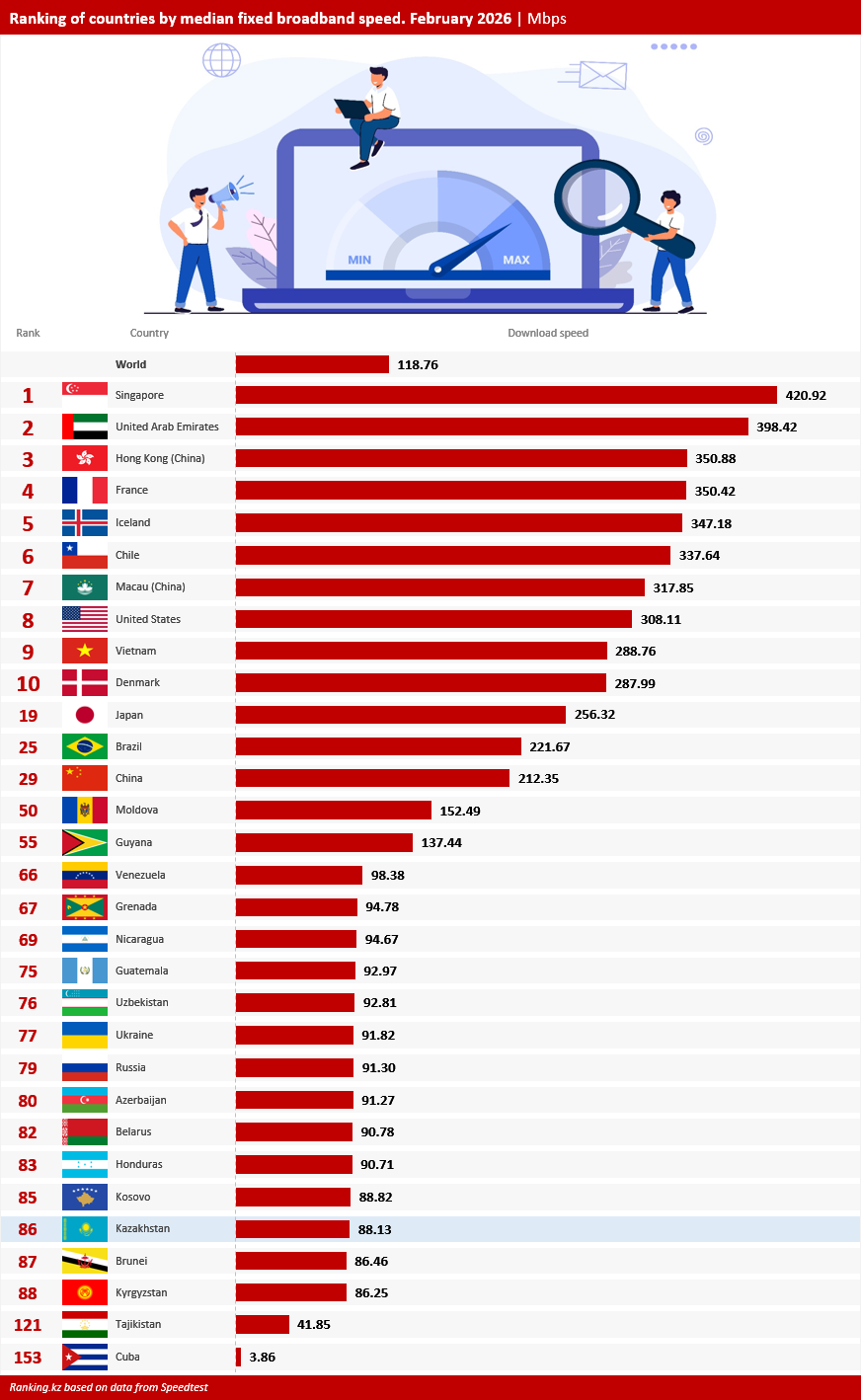
As of February 2026, according to the Speedtest Global Index, the global median fixed broadband speed reached 118.8 Mbps, increasing by 20.5 Mbps year-on-year. Despite the overall global improvement in technical performance, Kazakhstan’s position in the international ranking has deteriorated.
Singapore (420.9 Mbps), the United Arab Emirates (398.4 Mbps), and Hong Kong (350.9 Mbps) led in download speeds during the reporting period. The top five also included France (350.4 Mbps) and Iceland (347.2 Mbps). Even countries outside the top five demonstrate speeds of around 300 Mbps, more than twice the global average.
Against this backdrop, Central Asian countries are significantly lagging behind. As of February this year, Kazakhstan recorded a median fixed broadband speed of 88.1 Mbps, below the global average and weaker than the performance of many countries, including regional peers. Over the year, the country’s position in the global ranking declined from 84th to 86th, placing Kazakhstan between Kosovo and Brunei.
Overall, Kazakhstan ranked behind a number of countries, including Guyana (55th), Venezuela (66th), Grenada (67th), Nicaragua (69th), Guatemala (75th), and Honduras (83rd).
Among CIS countries, Uzbekistan, Ukraine, Russia, Azerbaijan, and Belarus also outperformed Kazakhstan.
This indicates that other countries are developing their infrastructure at a faster pace. For comparison, neighboring Uzbekistan improved its position from 78th to 76th, while its download speed increased by 11.2 Mbps.
Arguments attributing weaker performance to Kazakhstan’s vast territory are not decisive. In Russia, whose area is 6.3 times larger than Kazakhstan’s, internet speed is higher at 91.3 Mbps. The stagnation in Kazakhstan’s ranking is therefore not driven by geography, but by the low efficiency of a monopolized market. With 66% of the fixed broadband segment controlled by a single operator — Kazakhtelecom JSC — the lack of incentives for aggressive network modernization results in lower performance compared to both larger markets (Russia) and regional peers with comparable digitalization dynamics (Uzbekistan).
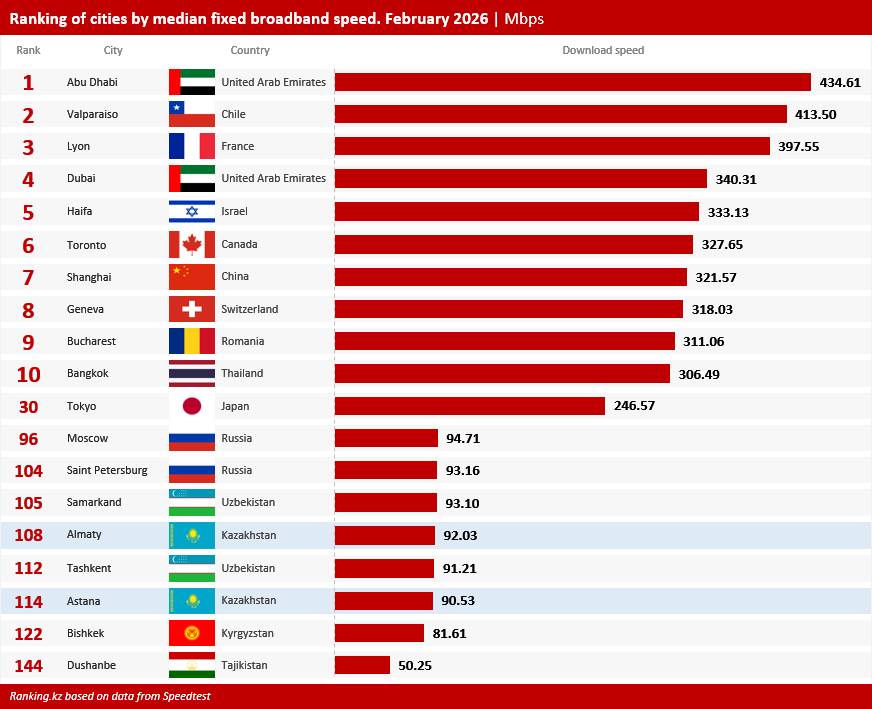
At the city level, the situation in Kazakhstan is also marked by declining international competitiveness. The country’s крупнейшие мегаполисы — Almaty and Astana — have significantly worsened their positions in the global ranking, dropping by 14 and 11 places, respectively.
The median speed in Almaty stood at 92 Mbps (108th globally), while Astana recorded 90.5 Mbps (114th). At the same time, Samarkand in Uzbekistan (93.1 Mbps) increased its speed by 16.9 Mbps, rising to 105th place globally and overtaking both of Kazakhstan’s key cities, while Tashkent (91.2 Mbps) also surpassed Astana.
The global ranking is led by Abu Dhabi (434.6 Mbps), Valparaiso (413.5 Mbps), and Lyon (397.6 Mbps). Notably, Moscow and Saint Petersburg ranked 96th and 104th, with median speeds of 94.7 Mbps and 93.2 Mbps, respectively, while Tokyo placed 30th with a download speed of 246.6 Mbps (Japan ranks 19th globally among countries, with a median speed of 256.3 Mbps).
The slow pace of improvement in connection quality and the decline in rankings occur against the backdrop of a highly concentrated fixed broadband market. Alongside the largest national operator, several smaller regional providers are present, but their market shares are insufficient to significantly influence the overall infrastructure development dynamics at the national level.