
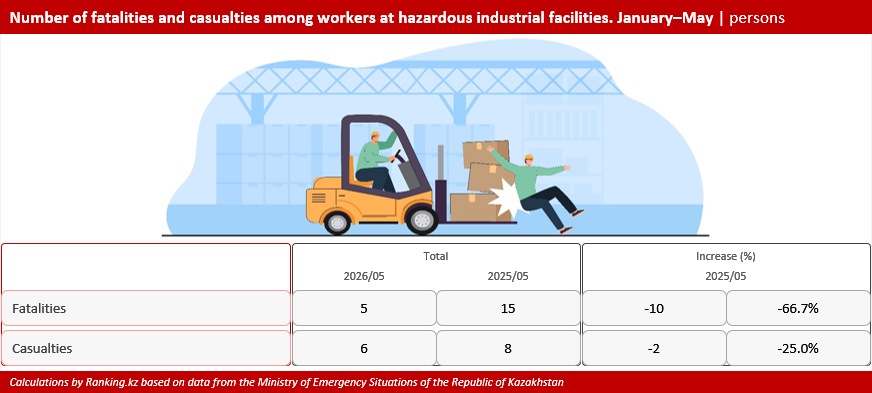
Five people in Kazakhstan lost their lives at hazardous industrial facilities during the first five months of this year — three times fewer than in the same period of 2025, when 15 fatalities were recorded. The number of injured workers also declined, falling from eight to six. In May 2026 alone, workplace accidents occurred at major industrial enterprises including Vostoktsvetmet and Kazzinc. According to the Ministry of Emergency Situations of the Republic of Kazakhstan, the incidents resulted from violations of industrial safety requirements. This suggests that the tragedies could have been prevented had the companies replaced worn-out equipment in a timely manner, properly organised working conditions and maintained stricter internal oversight.
Occupational injuries remain a serious social issue in Kazakhstan, affecting the lives and health of workers and their families. The issue is receiving close attention. Every case involving injury or loss of life raises questions about corporate responsibility — from investment in modernisation and workplace equipment to broader attitudes toward employees. As a result, the state is exercising increasingly rigorous oversight of companies operating in sectors where workers face elevated risks.
In April this year, President Kassym-Jomart Tokayev signed legislation introducing amendments to a number of Kazakhstan’s laws aimed at improving workplace safety and strengthening the protection of workers’ labour rights. The legislation introduces stricter requirements for industrial facilities, reduces the degree of worker liability in workplace accidents and strengthens the authority of commissions investigating such incidents. At the same time, the country’s relevant agencies continue to implement a wide range of measures aimed at achieving a specific goal: zero workplace injuries.
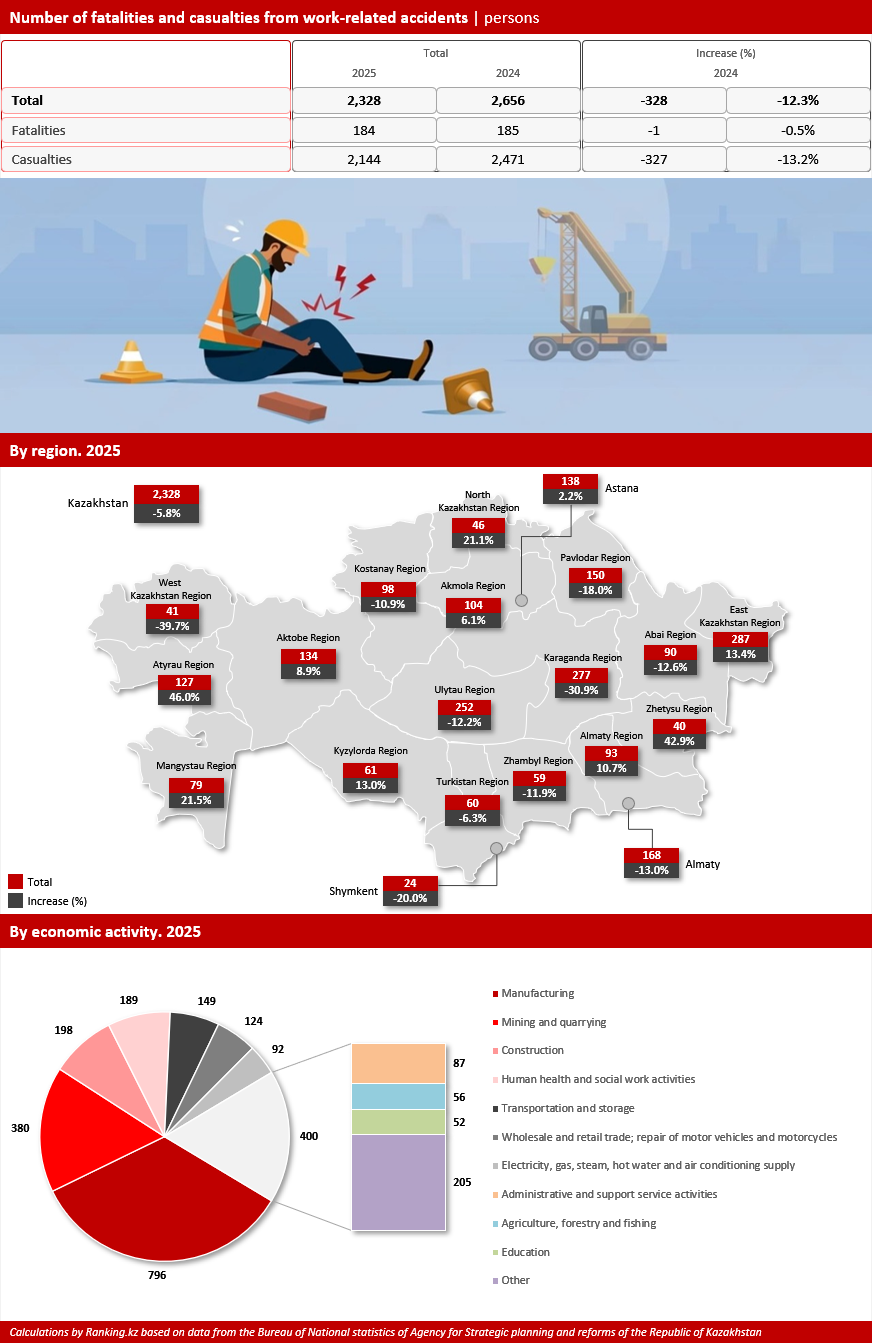
A broader view of the data points to the same trend. According to the Bureau of National Statistics of the Agency for Strategic Planning and Reforms of the Republic of Kazakhstan, workplace accidents across the country resulted in 2.3 thousand casualties in 2025 — down 12.3% from a year earlier. These figures cover all enterprises and industries, rather than only hazardous industrial facilities. The improvement was driven primarily by a decline in the number of injured workers. Some 2.1 thousand people sustained various injuries, a decrease of 13.2% year-on-year. This suggests that occupational safety measures are already delivering results, while the figures for the current year further reinforce the broader trend. The number of fatalities across all enterprises nationwide also declined in 2025, albeit by a modest 0.5%.
A closer look at the regional breakdown highlights significant disparities. The highest numbers of casualties and fatalities in 2025 were recorded in regions with large mining industries and related manufacturing activities: East Kazakhstan Region (287 people), Karaganda Region (277 people) and Ulytau Region (252 people).
Manufacturing accounted for 34.2% of all workplace casualties and fatalities, with 796 people affected, including 35 deaths. In mines, quarries and other extractive industry facilities, 380 people were injured or killed in 2025, including 19 fatalities. Other sectors with the highest numbers of workplace accidents included construction (198 people), healthcare (189 people) and transport and storage activities (149 people).
Overall, the positive trend extends beyond hazardous mining facilities and can be observed across workplace safety indicators throughout the economy.
Another important issue extends beyond officially recorded workplace injuries. Labour inspectors from the Ministry of Labour and Social Protection of the Population of the Republic of Kazakhstan also monitor concealed occupational accidents. These are cases in which employers effectively evade responsibility by failing to report incidents or by misrepresenting the circumstances surrounding them.
The risks associated with such practices are significant. Workers may be left to deal with medical consequences on their own, often facing additional financial burdens. Employers seeking to avoid regulatory scrutiny may fail to provide injured employees with the social protections and compensation to which they are entitled.
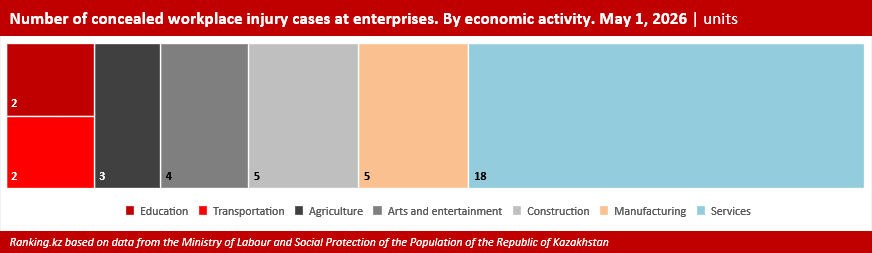
As of May 1 this year, specialists from the Ministry had already identified 39 cases involving the concealment of workplace injuries. Sectoral data show that such violations were most common in the private services sector, where companies accounted for 18 cases, or more than 46% of the total.
These figures indicate that occupational injuries are not solely a challenge for large mining and industrial enterprises. The issue is also prevalent among small and medium-sized businesses in the services sector, where workplace risks and labour rights violations remain a concern. This is why enhanced state oversight of labour rights and workplace safety standards will apply across the broader business community, rather than only to major industrial corporations. As part of these efforts, the Ministry of Labour and Social Protection of the Population is introducing a simplified risk assessment framework for small enterprises.
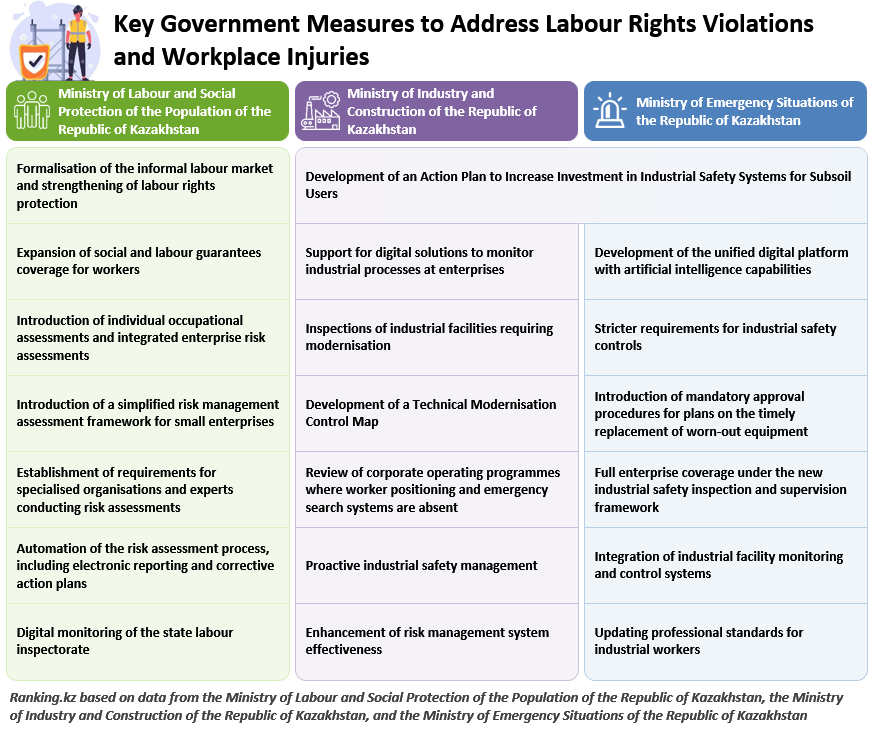
Responsibility for addressing workplace injuries in Kazakhstan is shared among several key government bodies, including the Ministry of Labour and Social Protection of the Population, the Ministry of Emergency Situations and the Ministry of Industry and Construction.
Several years ago, the Ministry of Emergency Situations established the Industrial Safety Committee, whose specialists oversee the safety of industrial and technological processes. The committee’s supervisory results for last year illustrate how Kazakhstan’s approach to preventing workplace violations is evolving. Although the number of violations identified at industrial enterprises remained broadly unchanged between 2024 and 2025, inspectors became far more likely to suspend operations. In 2024, the activities of 445 enterprises were halted until safety violations were remedied. By 2025, that figure had risen to 1.8 thousand enterprises — a fourfold increase. For companies found to be in breach of safety requirements, such measures, combined with mandatory corrective action, often prove more effective than fines and subsequent inspections.
According to Emergency Situations Minister Chingis Arinov, Kazakhstan has introduced a new industrial safety oversight mechanism this year that covers all enterprises nationwide. The country is also moving to align its legislation with updated International Labour Organization standards, with a particular focus on digitalisation and the adoption of artificial intelligence technologies.
One of the key initiatives currently under development is the digital industrial safety platform, commissioned by the Ministry of Emergency Situations and scheduled for completion by the end of this year. The government also plans to integrate automated occupational health and safety systems with the information systems of the Ministry of Health, the Ministry of Justice, the Ministry of Emergency Situations, the Ministry of Finance and the General Prosecutor’s Office. The integration is expected to improve the timely identification of risks and enable faster responses to violations of labour rights and potential workplace safety incidents.

To improve the prevention of workplace accidents, specialists from the Ministry of Emergency Situations, together with experts from the Ministry of Industry and Construction, have developed and approved an action plan aimed at increasing investment in industrial safety systems at mining enterprises. A review of 55 mines and ore extraction sites found that 18% of them — 10 facilities — lacked worker positioning and emergency search systems. Agreements on financing such systems have already been reached with the management of three facilities, while another five companies are currently selecting technical solutions and equipment suppliers. Safety infrastructure also requires upgrading at the remaining 45 sites.
The Ministry of Labour and Social Protection of the Population is likewise pursuing an active digitalisation agenda in the labour sphere, contributing to improvements across a range of workplace safety indicators.
One area of focus is the formalisation of employment relationships and the reduction of informal labour practices. By requiring employers to comply fully with labour legislation, the ministry is helping to safeguard workers’ rights while also ensuring access to compensation and insurance payments in the event of workplace accidents.
Labour and Social Protection Minister Askarbek Yertayev noted: “Work is underway to protect labour rights, including the legalisation of employment and the expansion of insurance coverage. At present, 118 thousand enterprises are covered by mandatory occupational accident insurance, representing 68% of all active legal entities. A total of 19 thousand collective agreements have been digitised, twice as many as a year earlier. Since the beginning of the year, 170 preventive inspections have been conducted, with coverage increasing 2.5-fold compared with the same period of 2025.”
The ministry is also introducing automated risk assessment systems and digital monitoring tools for the state labour inspectorate. The scope extends beyond industrial safety to include labour disputes, labour rights violations and other workplace issues. Around 98 thousand enterprises have been incorporated into the monitoring framework, resulting in the creation of a labour risk map. Approximately 2.3 thousand companies have been classified as high risk, while a further 3.2 thousand have been assigned medium-risk status.
Another priority is the overhaul of Kazakhstan’s outdated system for assessing working conditions and preventing occupational injuries. According to the ministry, challenges persist, including a formalistic approach to occupational safety by some employers, delays in providing workers with protective equipment and the continued use of outdated machinery. To address these issues, legislative reforms are introducing individual assessments for each profession alongside integrated enterprise-level risk assessments. The ministry is also establishing requirements for specialised organisations and experts responsible for conducting such evaluations. The objective is to move from a reactive model focused on investigating accidents after they occur to a proactive system that identifies risks and violations in advance, enabling companies to take corrective action before injuries occur.
These and other initiatives undertaken by the relevant authorities are aimed at systematically eliminating risk factors, reducing workplace injuries and, ultimately, preventing them altogether.