
The development of the digital economy and the spread of online payments, cryptocurrency services and investment instruments are transforming not only the financial market but also the methods of financial crime. While only a few years ago criminal proceeds were primarily laundered through real estate purchases or bank accounts, today such schemes have become significantly more complex and technologically sophisticated.
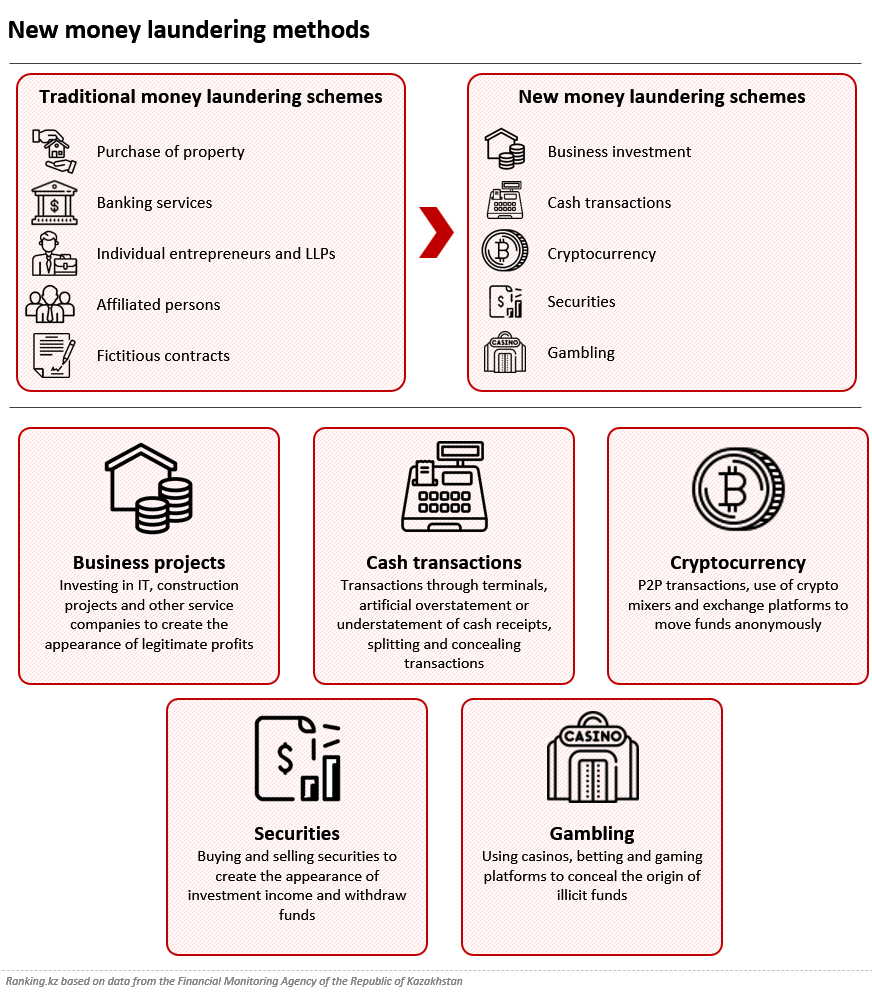
According to the Financial Monitoring Agency of the Republic of Kazakhstan (FMA), 140 criminal cases involving the legalization (laundering) of criminal proceeds were registered in Kazakhstan in 2025 — 84% more than a year earlier. This was the highest figure in the past ten years. Investigations have already been completed in 98 cases, while 93 cases have been referred to court.
At the same time, the increase in the number of such cases does not necessarily indicate a sharp rise in crime itself. To a large extent, it reflects stronger financial intelligence efforts, the development of the FMA’s analytical tools and more effective detection of complex financial schemes.
Fraud remains the main source of criminal proceeds
Money laundering is almost never a standalone crime. It is the final stage after illegally obtained proceeds have been generated and need to be given the appearance of legitimate origin.
According to the FMA, the main predicate offenses* in 2025 were:
- fraud (Article 190) — 31%;
- financial pyramids (Article 217) — 18%;
- misappropriation or embezzlement of property (Article 189) — 13%;
- illegal entrepreneurship (Article 214) — 13%;
- creation of an organized criminal group (Article 262) — 11%.
These five categories accounted for almost 86% of all detected cases of laundering criminal proceeds.
This shows that the largest volumes of illicit funds today are generated through economic crime, online fraud, financial pyramids and illegal business activities.
Less common predicate offenses are also worth noting, including the organization of illegal gambling operations, causing property damage through deception, as well as evasion of taxes and other mandatory payments to the state budget.
* primary underlying criminal offenses through which money or property is illegally obtained
How criminal money becomes “legal”
The classic money laundering scheme has remained largely unchanged.
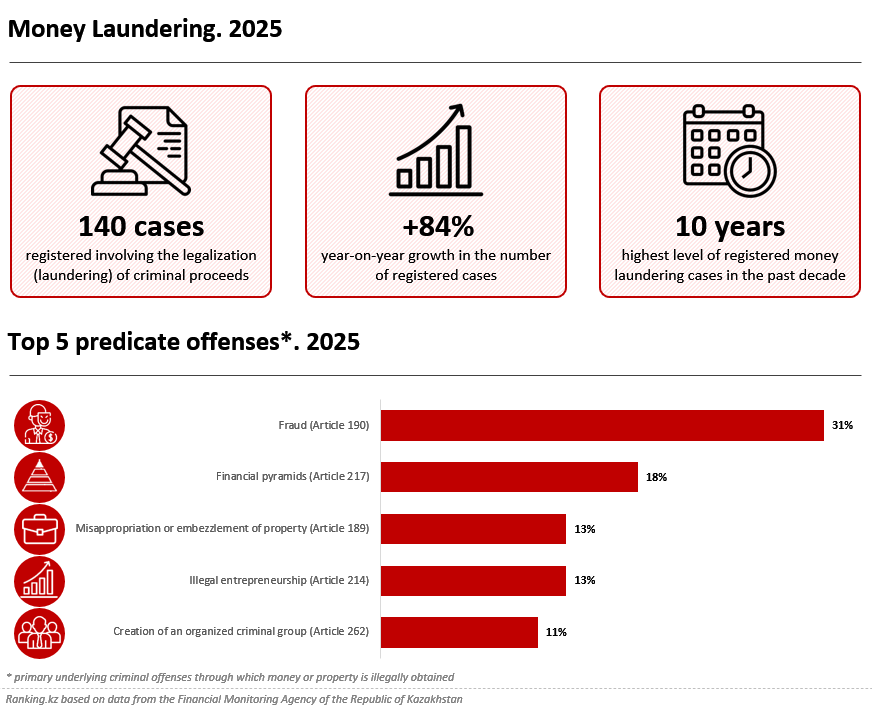
First, illegally obtained funds are generated. They are then moved through a series of financial transactions designed to conceal their origin. The assets are subsequently made to appear legitimate, after which the money is returned to the formal economy.
In practice, there are three main stages:
- concealing the origin of the money;
- moving it repeatedly through various financial instruments;
- integrating the funds back into the legitimate economy.
The greater the number of intermediate transactions, the more difficult it becomes to trace the funds back to their original source.
How criminal proceeds are most commonly laundered
Despite the development of digital technologies, the most common method remains the use of trusted individuals.
According to the FMA, the main money laundering channels in 2025 were:
- use of close associates and shell companies — 64%;
- acquisition of movable and immovable property — 62%;
- banking instruments (deposits, loans, accounts) — 24%.
In most cases, several methods are used simultaneously. For example, criminal proceeds may first be transferred through the accounts of a controlled company, then used to purchase real estate, after which the property is sold as a formally legitimate asset.
From real estate to cryptocurrency
The most notable trend in recent years has been the shift in the methods used to launder criminal proceeds.
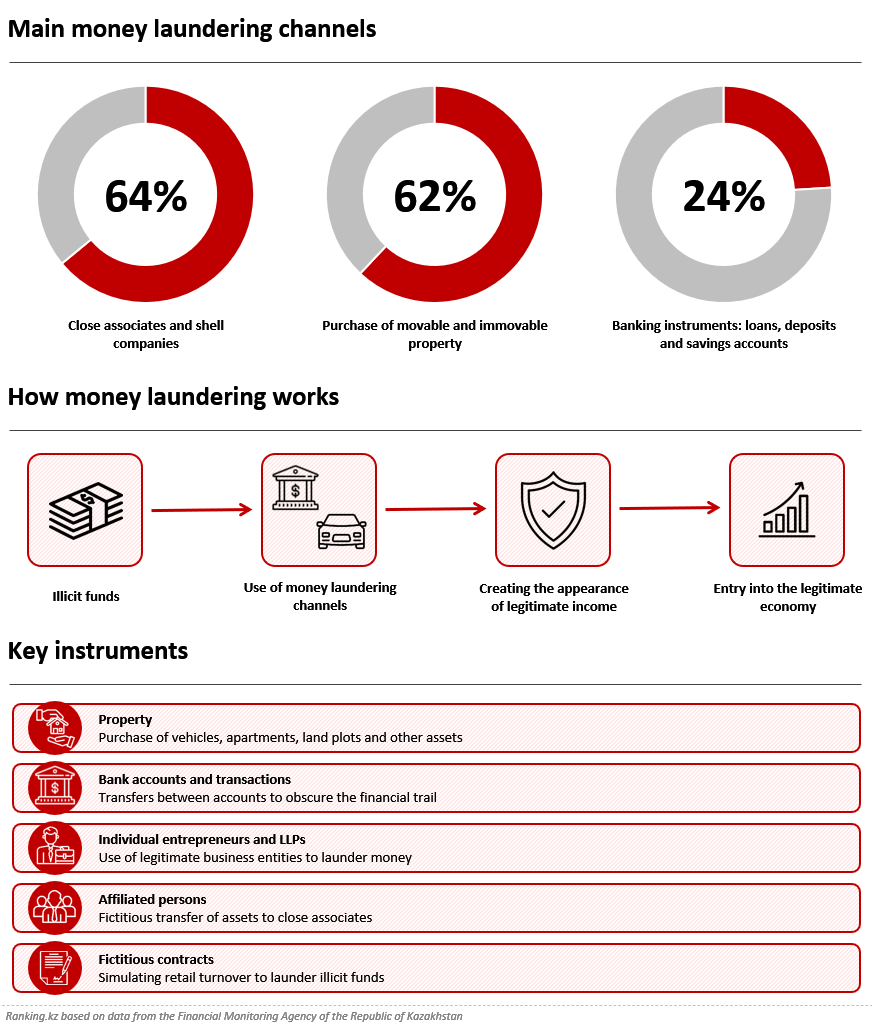
Traditional schemes continue to be used:
- purchasing real estate;
- banking transactions;
- registering property in the names of affiliated persons;
- fictitious contracts;
- use of individual entrepreneurs and companies.
At the same time, new instruments are increasingly being used.
Today, criminals are increasingly turning to:
- cryptocurrency;
- investment projects;
- cash transactions;
- securities transactions;
- gambling businesses.
Digital assets in particular are becoming one of the most convenient ways to move funds quickly between countries without relying on traditional banking infrastructure.
Why new schemes are more dangerous
Modern money laundering methods have several distinctive features.
First, they resemble ordinary business activity. Real companies are established, contracts are signed, accounting records are maintained and bank payments are processed.
Second, modern financial instruments are used, including investment projects, cryptoassets, electronic payments and securities trading.
Third, financial flows themselves are split into numerous smaller transactions, making them significantly more difficult to detect.
This is why investigations into such crimes increasingly require analytical technologies, digital monitoring and interagency information sharing.
Implications for the financial system and the economy
The growing number of detected schemes reflects not only the evolution of financial crime but also the development of the national system for combating money laundering.
Today, combating money laundering is becoming one of the key elements of a country’s financial security. The effectiveness of this system directly affects the stability of the banking sector, the economy’s investment attractiveness, confidence in the country’s financial system, and the economic security of the state and its citizens.
Government agencies are therefore gradually shifting their focus from detecting crimes that have already been committed to preventing them through risk-based transaction monitoring, improvements to legislation and the development of digital financial intelligence tools. Kazakhstan pays particular attention to this area: measures are in place to mitigate money laundering risks, while the national risk assessment for anti-money laundering and counter-terrorist financing is regularly updated.