
The development of the healthcare system is impossible without a sufficient level of staffing with doctors and mid-level medical personnel. Human resources largely determine the quality and accessibility of healthcare services, the speed of diagnostics, the effectiveness of treatment, and the resilience of the healthcare system as a whole. Amid population growth, urbanisation, and increasing pressure on medical institutions, the issue of healthcare staffing is becoming one of the key factors shaping the sector’s development.
It is no coincidence that this indicator is included among the important metrics of the UN Sustainable Development Goals (SDGs), particularly SDG No. 3 — “Good Health and Well-Being”. The availability of doctors and medical personnel is directly linked to achieving universal access to healthcare services, reducing mortality, and improving the quality of life of the population. As a result, countries around the world, including Kazakhstan, are paying increasing attention to the training of healthcare professionals, the development of the education system, and the creation of conditions to attract specialists to the sector.
However, in recent years Kazakhstan has been experiencing a decline in the level of staffing both with doctors and with mid-level medical personnel.
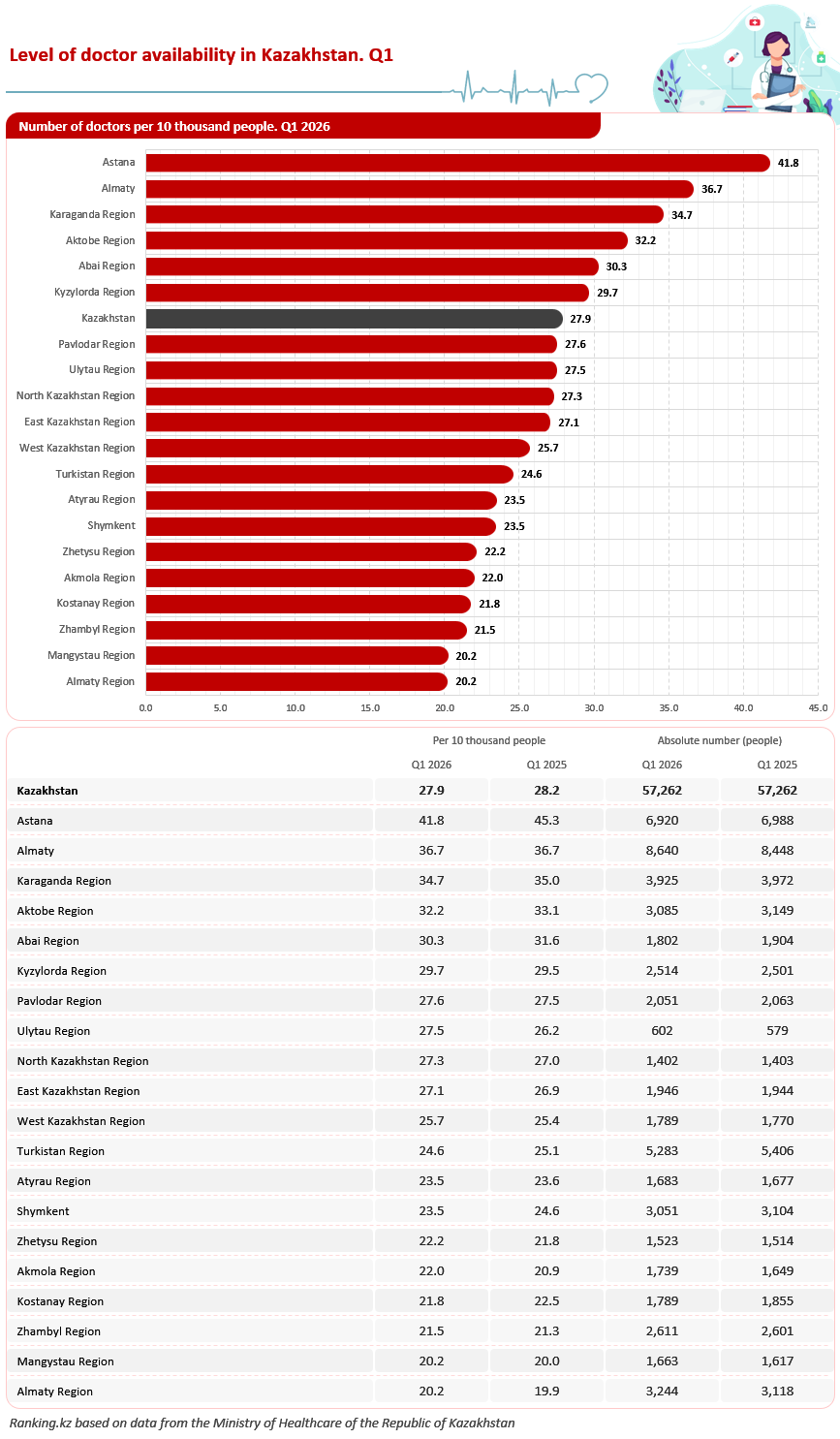
By the end of the first quarter of 2026, the country had more than 57 thousand doctors — approximately the same number as a year earlier. At the same time, slight changes in the number of doctors can be observed across individual regions.
Despite the fact that the total number of doctors in the country is barely changing, the level of doctor availability per capita is gradually declining — and this is an alarming trend. The number of doctors per 10 thousand people decreased over the year from 28.2 in the first quarter of 2025 to 27.9 in the first quarter of 2026. And this is only part of the problem. Regional disparities remain another major issue.
For example, only 6 out of 20 regions exceed the national average in terms of doctor availability. In Astana, there are 41.8 doctors per 10 thousand people — 50% above the national average — while Almaty records 36.7 doctors (31.6% above the national average), and Karaganda Region posts 34.7 doctors (24.4% above the national average). Meanwhile, densely populated Almaty Region has just 20.2 doctors per 10 thousand people — the lowest indicator in the country and 27.5% below the national average. A similar situation is observed in Mangystau Region, with 20.2 doctors, Zhambyl Region, with 21.5, Kostanay Region, with 21.8, and Akmola Region, with 22 doctors per 10 thousand people.
Disparities are also visible in the dynamics of doctor availability: in some regions the indicator is declining year-on-year — for example, by as much as 7.6% in Astana — while in others it is increasing by more than 5%. More detailed information is presented in the infographic below.
For comparison, while Kazakhstan currently has around 28 doctors per 10 thousand people, Belarus has 47.2 doctors (as of 2023), Russia has 51.1 doctors (as of 2022), and Georgia has 56.4 doctors (as of 2023). In Lithuania, Belgium, Greece, Denmark, Malta, and Monaco, the indicator exceeds 60 doctors per 10 thousand people.
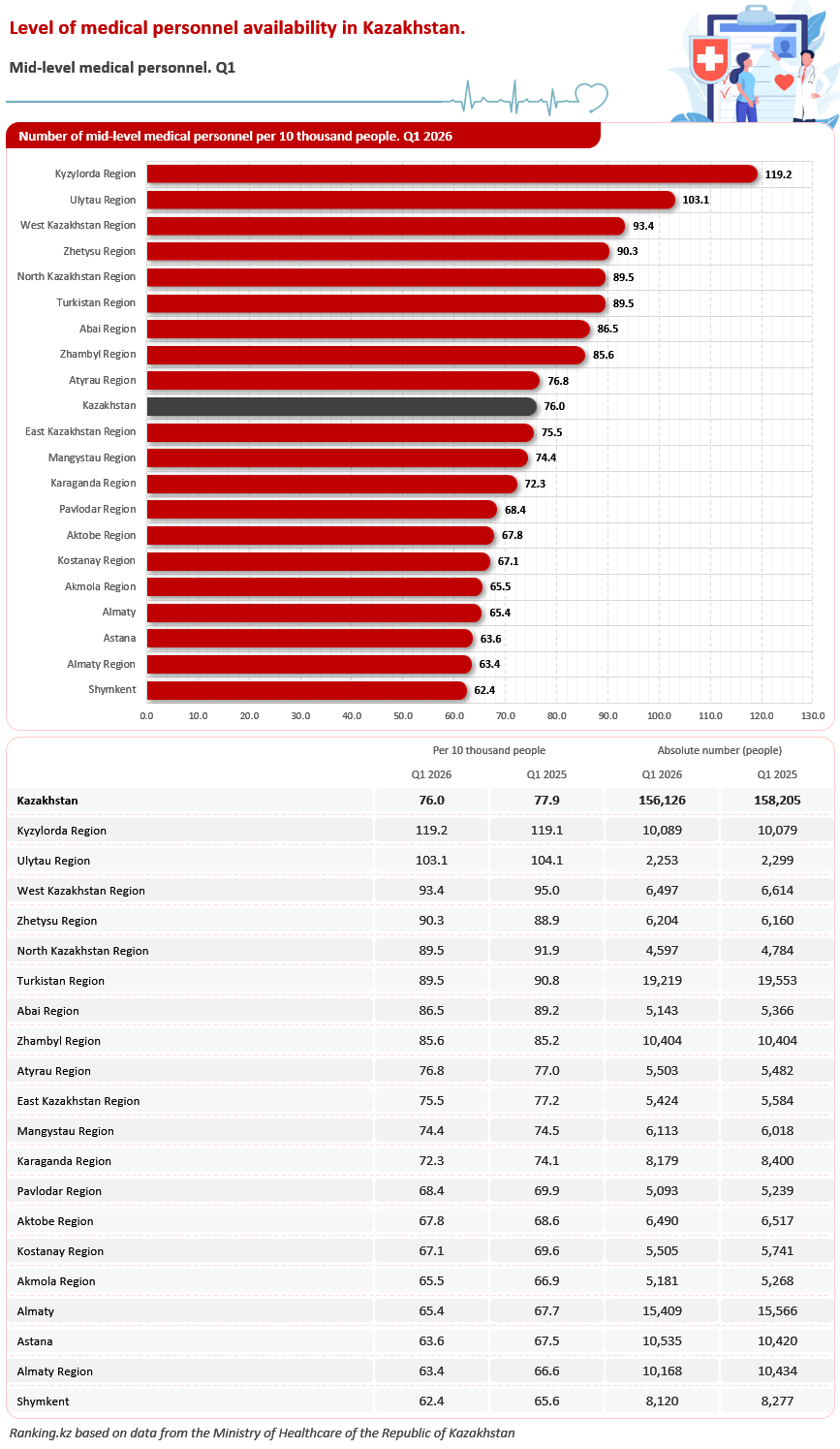
At the same time, the availability of mid-level medical personnel is also declining. This category includes nurses, paramedics, midwives, radiology technicians, and other specialists.
By the end of the first quarter of 2026, Kazakhstan had 76 mid-level medical workers per 10 thousand people, down 2.4% compared to a year earlier (77.9 per 10 thousand people in the first quarter of 2025). At the same time, the problems remain the same: the country continues to experience a decline in the number of mid-level medical personnel, alongside significant regional disparities. More detailed information is presented in the infographic below.
Thus, despite the overall number of doctors in the country remaining stable, Kazakhstan is already facing a gradual decline in the availability of medical personnel per capita. Against the backdrop of population growth and increasing pressure on the healthcare system, this trend could become a serious challenge both for the quality of medical care and for the accessibility of healthcare services, especially in regions with the lowest levels of doctor availability.
Additional concern is caused by the persistent regional imbalance, under which a significant share of medical specialists remains concentrated in large cities and selected regions, while a number of territories continue to experience staff shortages. In the long term, this may deepen inequality in access to quality healthcare services.
Under these conditions, measures aimed at training new specialists, developing medical education, increasing the attractiveness of the profession, and creating incentives for doctors to work in the regions become especially important. The effectiveness of personnel policy today will largely determine the resilience of the healthcare system and the country’s ability to achieve its public health goals and the UN Sustainable Development Goals.