
In 2026, global geopolitics remains in a phase of acute military confrontation. The results of 2025 recorded the highest level of tension since World War II. In an environment where military power takes priority, the importance of reputational capital becomes a key factor in maintaining investment attractiveness and foreign policy agency.
In January of this year, the annual report “Global Soft Power Index 2026” by Brand Finance was released. Data collection took place in September and October 2025 (prior to the military confrontation involving the United States and Israel with Iran) and covered 150 thousand respondents across 100 markets. All 193 UN member states were assessed. The index includes three core KPIs (familiarity, reputation, and influence) and 55 metrics grouped into eight pillars (culture and heritage, education and science, international relations, business and trade, governance, media and communications, sustainable future, and people and values). The assessment is based on 35 national brand attributes. Soft power reflects a country’s ability to shape global public opinion through culture, diplomacy, business, and international influence.
The 2026 results confirm a crisis of trust in Western governance institutions amid prolonged conflicts. The United States ranked first with a score of 74.9, although it recorded a record decline of 4.6 points. The main deterioration was observed in the “governance” and “international relations” categories. China ranked second with a score of 73.5, significantly narrowing the gap with the leader. For the first time in the index’s history, China surpassed the United States in “reputation.” Japan, with a score of 70.6, entered the top three, displacing the United Kingdom. Among the laggards in terms of dynamics were G7 countries, reflecting economic instability and weakening diplomatic influence. Russia ranked 14th, improving both its score (plus 0.6 points) and its position (up two places).
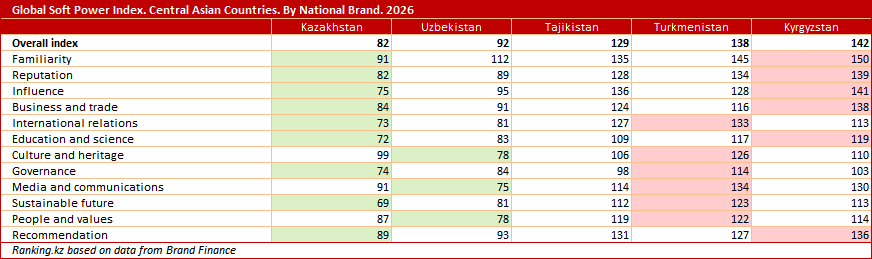
Kazakhstan retains its position as the regional leader in Central Asia, although the pace of index growth remains moderate. The country ranked 82nd with a score of 35.9, gaining 0.8 points and moving up five positions compared to the previous year. Uzbekistan rose by seven places to 92nd, with a score of 34.5 and an increase of 1.1 points. Tajikistan ranked 129th, Turkmenistan 138th, and Kyrgyzstan 142nd. Among Central Asian countries, the strongest improvement was recorded in Tajikistan (plus 1.3 points and up 12 positions), while the weakest performance was observed in Turkmenistan (plus 0.1 points and down four positions).
Competition for the status of the most attractive national brand is intensifying in the region. Kazakhstan remains the leader among Central Asian countries, although Uzbekistan demonstrates an advantage in humanitarian and information-related dimensions. The other countries in the region are positioned in the lower half of the second hundred in the global ranking across most indicators.
Kazakhstan leads Central Asian countries across the core KPIs: “familiarity” (91st), “reputation” (82nd), and “influence” (75th). The country ranks highest in such metric groups as “education and science” (72nd), “governance” (74th), and “business and trade” (84th), and has the strongest investor recommendations (89th). Kazakhstan also demonstrates a clear advantage in the “sustainable future” category (69th), reflecting its environmental and energy agenda.
Uzbekistan outperforms Kazakhstan in three areas: “culture and heritage” (78th), “media and communications” (75th), and “people and values” (78th). This indicates more active promotion of the national image in the global information space. At the same time, in core economic indicators and familiarity, Uzbekistan still lags behind Kazakhstan.