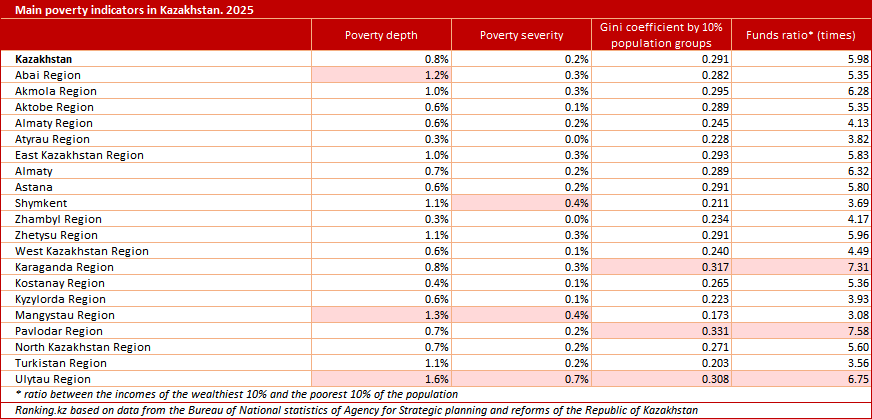

In 2025, Kazakhstan’s poverty depth stood at 0.8%, poverty severity at 0.2%, the Gini coefficient at 0.291, and the funds ratio at 5.98 times. Overall, this points to a moderate level of poverty and income inequality, although the regional situation differs dramatically.
The most severe situation in terms of poverty depth was observed in Ulytau Region, where the indicator reached 1.6% — the highest level in the country. This means that the poor population in the region experienced the largest average shortfall from the subsistence minimum. Mangystau Region followed with 1.3%, Abai Region with 1.2%, while Shymkent, Zhetysu Region, and Turkistan Region each recorded 1.1%.
Ulytau Region also became the anti-leader in terms of poverty severity, at 0.7%. The indicator reflects the concentration of the extremely poor population within the broader poor population group. High values were also recorded in Mangystau Region and Shymkent, at 0.4% each, as well as in Abai Region, Akmola Region, East Kazakhstan Region, Zhetysu Region, and Karaganda Region, all at 0.3%.
The highest income inequality by the Gini coefficient was observed in Pavlodar Region, at 0.331. It was followed by Karaganda Region, at 0.317, and Ulytau Region, at 0.308. This indicates the most pronounced income stratification among the population.
Pavlodar Region also became the anti-leader in terms of the funds ratio: the incomes of the wealthiest 10% of the population exceeded those of the poorest 10% by 7.58 times. High values were also recorded in Karaganda Region, at 7.31 times, Ulytau Region, at 6.75 times, and Almaty, at 6.32 times.