
Access to clean water and basic hygiene remains an area of acute global social inequality. Despite international commitments, the world is demonstrating dangerous stagnation that results in millions of preventable deaths every year.
Globally, the situation reflects the failure of sustainable development strategies. More than 1.4 million people die annually due to WASH factors — the lack of safe water, adequate sanitation, and hygiene. The greatest burden falls on children under the age of five, for whom diarrhoeal infections remain a death sentence in conditions of limited access to clean water: around 1 thousand young children die every day worldwide. According to the JMP 2025 report, one in four people globally — or 2 billion individuals — still lacks access to safely managed drinking water services, while the pace of progress in the sanitation sector must accelerate at least fivefold to stop the current wave of mortality.
Against this backdrop, the situation in Kazakhstan appears less severe, although it remains far from satisfactory. Mortality linked to the lack of safe water, sanitation, and hygiene in the country remains unstable. In 2025, the indicator increased to 0.85 per 100 thousand people, compared to 0.75 a year earlier.
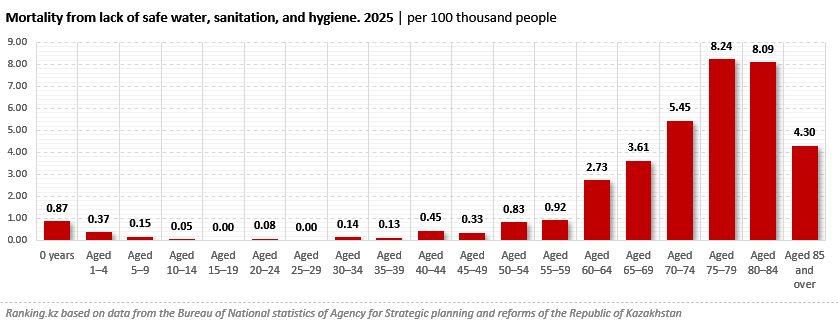
Mortality linked to WASH factors rises sharply with age. Last year, the indicator among Kazakhstan residents aged 60–64 reached 2.73 per 100 thousand people, increasing to 3.61 among those aged 65–69, 5.45 among those aged 70–74, and as high as 8.24 among people aged 75–79.
By comparison, the indicators among children and young people were close to zero. Infant mortality linked to the lack of safe water, sanitation, and hygiene also stands out separately: among children under the age of one, the figure reached 0.87 per 100 thousand people. This points to problems with basic living conditions already at the earliest stage of life.