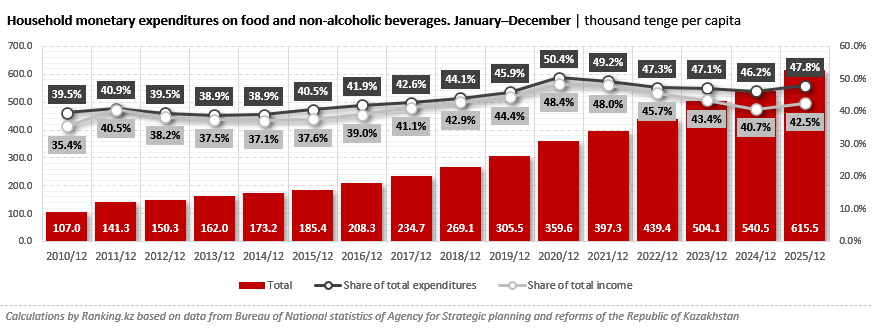

A high share of food spending remains the primary marker of low household welfare in Kazakhstan. By the end of 2025, average per capita expenditures on food and non-alcoholic beverages reached 615.5 thousand tenge. This is a 13.9% increase compared to the previous year, while in the long term, since 2010, nominal spending has grown nearly sixfold.
At the same time, the structural burden on household budgets is not decreasing. In 2025, the share of food expenditures in total spending amounted to 47.8% — only slightly below the peak levels of the pandemic period. In 2020, the country had already crossed the threshold when food spending reached a record 50.4% of total household expenditures. The indicator has not returned to previous levels. Even with some decline, the share remains elevated, indicating persistent structural pressure, with a significant portion of spending still allocated to basic needs.
Despite the growth in nominal incomes, a substantial share is absorbed by maintaining a standard consumption basket, leaving less disposable income for other purposes. In January–December 2025, food and non-alcoholic beverages accounted for 42.5% of total income, compared to 40.7% a year earlier.
The situation is further aggravated at the regional level, where in a number of regions household budgets have effectively turned into a mechanism for purchasing food. The highest absolute spending on food in January–December 2025 was recorded in Almaty: 843.1 thousand tenge per capita, 37% higher than the national average. However, absolute values are only part of the picture. More important is the share of the budget consumed by food. In Zhetysu Region, residents spent 59.1% of their total income and 55.7% of total expenditures on food — more than half of both what they earned and what they spent. In Zhambyl Region, the figures were similar: 55.9% of income and 56.4% of expenditures. In Turkestan Region, the shares stood at 52.9% and 57.2%, respectively. For comparison, in Almaty, spending on food and non-alcoholic beverages accounted for 45.2% of income and 48.6% of total expenditures.
More moderate food spending within household budgets was observed in Astana: 34.4% of income and 42.6% of expenditures. In Karaganda Region, food accounted for 33.6% of income and 38.5% of expenditures, while in Kostanay Region the figures were 32.4% and 42.7%, respectively.